














When it comes to installing a carpet in your home or commercial property, there are a number of options available to you. Two of the most common methods are glue down installation and stretch in carpet installation. In this post, we are going to talk about both those methods, but more specifically, we are going to look at the best type of glue for carpet installation, looking at the benefits of using a glue down approach and the things you need to consider when gluing a carpet.
Techniques for installing a carpet
Two of the most common installation methods for laying a new carpet are glue down and stretch in. On very rare occasions, you might see the cut to fit method deployed, however, this is really only utilised in specific circumstances and is not a fixed option so is less common.
Direct glue down carpet installation
The direct glue down method is the most common installation technique for commercial carpets and is occasionally deployed in residential installations. This method involves gluing the carpet directly to the floor and is only recommended for extremely smooth floors. When no underlay is present and the floor is not even, these imperfections are visible through the carpet and that’s why glue down is a great technique to use when you have a smooth concrete floor for example.
Another option, sometimes referred to as the double glue down installation method, is to first glue down an underlay or pad and then glue the carpet to the pad. The underlay pad acts as additional cushioning and can also help to mask any imperfections with the floor. Underlay padding is also a more comfortable way of installing a carpet, provides insulation and extends the life of the carpet.
The advantages of this technique are that it provides an extremely stable carpet installation with very little movement, and it is suited to large areas. It is good for rolling traffic, including wheelchairs and can be deployed on ramps.
Stretch in carpet installation
The stretch in carpet installation technique is the most common way of installing carpets in the home. Using this technique, strips of wood (known as tack strips or gripper rods) are nailed or glued to the outside of a room. These strips have hundreds of tiny nails that stick up and point away towards the wall.
Underlay or padding is usually secured to the floor in the middle of the room and then the carpet is attached to the nails around the outside of the room by stretching the carpet tightly across the room where it grips the nails that point towards the walls.
The stretch in technique does have some advantages – it’s a quick installation method and easier to remove than glued down carpet, however, it is not suitable for large spaces due to concerns over buckling or rippling and is not ideal for heavy traffic, hence why it is more common in the home than in the workplace.
What glue is best for carpets?
If you are looking at using the glue down technique, it’s important to select the best glue for the job. There are a number of options available on the market and it’s important to get a glue that meets your requirements depending on where the carpet will be located, the expected traffic on the carpet and the expected lifespan of the carpet.
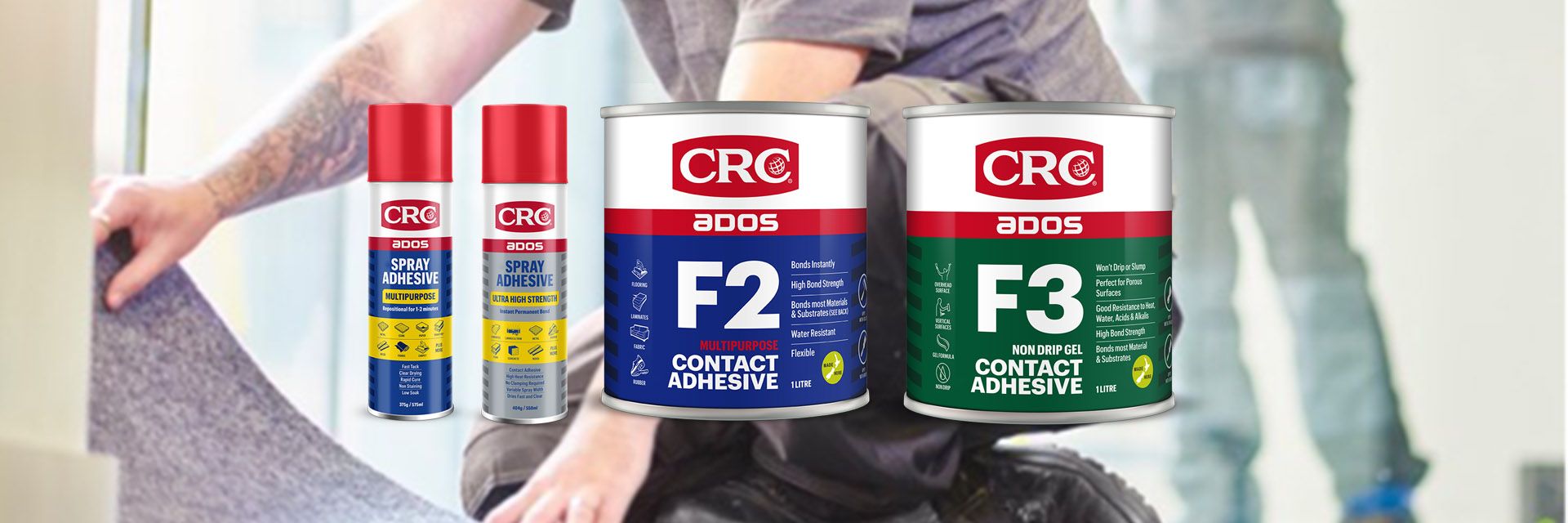
Here at CRC, we have four carpet glues that come highly recommended and should meet your needs, no matter where you are installing your carpet.
CRC Multi-Purpose Spray Adhesive
CRC Multi Purpose Spray Adhesive is a spray glue that bonds most materials quickly and easily, giving a long-lasting bond. It is formulated to give a fast tack-off, low-soak spray and dries clear. It is a pressure-sensitive one-way adhesive that remains repositionable for 1-2 minutes eliminating costly errors with expensive materials. Once positioned, the adhesive will bond within 10-20 minutes. Full cure will take 24 hours.
Features and Benefits:
- Reliable - High strength
- Convenient - Rapid cure, fast tack
- User friendly - Non staining/low mist
- Aerosol - No cleanup
- Easy to Use - Repositionable, clear drying
- Cost-effective - Low soak
- Low odour - Safe for indoor use
Applications:
Bonding wood, paper, metal, most plastics, fibreglass, leather, carpet, PVC foam, cardboard, cloth, fabrics, foils, cork, some rubbers, felt, labeling, sail cloths, photographs.
CRC UHS Spray Adhesive
CRC UHS is an ultra high strength contact adhesive which gives an immediate and permanent bond on a wide variety of surfaces. It is formulated to give low soak, cure fast, dry clear and be non-staining. It has high heat resistance and is suitable on porous and non-porous surfaces making it ideal for a wide variety of applications, where permanent, high strength bonds are essential. CRC UHS uses a unique resin system making it resistant to breakdown from plasticiser migration. CRC UHS aerosol is fitted with a variable nozzle, which allows controlled, accurate spraying, reducing product wastage and limiting over-spray.
Features and Benefits:
- Ultra-High Strength - Instant Permanent Contact Bond
- High Heat Resistance - Up to 75°C
- Plasticiser Safe - Resistant to breakdown from plasticiser migration
- Easy to Use - No clamping required
- Variable Nozzle - Allows controlled, accurate spraying and a variable spray width
Applications:
Bonding porous & non-porous surfaces. Wood, metal, concrete, flooring (cork tiles, carpet, linoleum, hardwood, laminate), some plastics, particle board, foam. It is not suitable for use on polystyrene.
CRC F2 Contact Adhesive
CRC F2 Multipurpose Contact Adhesive is a high-performance general-purpose contact adhesive. It is water-resistant and flexible and its high bond strength makes it ideal for a wide range of uses. It is easily applied, highly versatile, durable and bonds instantly to most substrates.
Features/Benefits:
- Versatile
- Multipurpose
- High bond strength
- Bond most materials and substrates
- Water resistant / flexible
- Ideal for a wide variety of uses
Applications:
Exceptional performance for making bonds with laminated plastics, hardboard, sheet metals, foam plastics, some rubbers, felts, acoustic tiles, leather, most building materials, etc.
CRC F3 Non Drip Contact Adhesive
CRC F3 is a thixotropic, high strength contact adhesive. It is formulated to be non-spill and non-drip, giving greater control of application and better coverage. This gel feature makes it ideal for vertical and ceiling applications and for bonding onto porous surfaces, e.g. Gib board. CRC F3 will not soak in as other liquid adhesives do, giving excellent results on porous surfaces such as the end grain of particle board. CRC F3 has good resistance to heat, water, acids and alkalis, essential for a wide variety of commercial applications.
Features/Benefits:
- Thixotropic - Ideal for vertical, overhead and porous surfaces
- Non-spill, non-drip
- Greater control of application and better coverage
- Resilient
- Good resistance to heat, water, acids and alkalis
Applications:
Laminated plastics, hardboard and aluminium to wood, brick or metal. PVC cloths, plastics and rubber to wood, concrete, cardboard. Felt to wood, cardboard and metal. Acoustic ceiling tiles to wood, concrete etc.
Factors to consider when purchasing a carpet glue
When you are deciding on which carpet glue to purchase, there are a number of factors you need to take into consideration.
Effectiveness
The primary factor to consider is the overall effectiveness of the glue, especially when used in a commercial or industrial setting. You need to invest in a carpet glue that is going to last. It needs to be easy to install, create a strong bond and ideally dry clear and colourless for seamless repairs and non-staining.
Coverage
In order to get the most value for money from your carpet glue, you need to consider the coverage you will get from each can/container. This is just one of the factors to be considered when looking at the value for money of your carpet glue.
Reviews
Where possible, seek out reviews from other customers to find out more about the carpet glues you are considering. Look beyond just the manufacturers website and look at retailers where you will likely find customer reviews that may provide social proof about the effectiveness of the carpet glues you are considering.
Environmentally friendly
Not all carpet glues are created equal, and some are better for the environment than others. Typically, water-based glues will be a better option for those looking for an eco-friendly carpet glue. They use less chemicals and give off low emissions, making them a great option around the house.
In Summary
We are often asked the question, “can you glue down carpet?” and the overwhelming answer is yes. At CRC, we have a wide range of adhesives to suit every job and our four carpet adhesives offer great options for customers depending on your needs.